Showing posts with label Cinema. Show all posts

Saturday, December 15, 2012

The Ultimate Fantasy Girlfriend: Greta Garbo


My great comedy heroes, Peter Cook and Dudley Moore, probably invented the concept of the 'Fantasy Girlfriend', or created it for me, at any rate, when I first heard this celebrated skit of theirs at about the age of 12. My French teacher at school had a huge library of recorded comedy, mostly radio shows from his own youth, and would treat us to extended sessions of this rather than continuing with lessons in the last week or two of term, after our exams were out of the way. This provided my first exposure to a lot of classic BBC radio comedy like ITMA and Round The Horne and Hancock's Half Hour, and also to the great monologists like Gerard Hoffnung, Victor Borge, Peter Ustinov, Alan Bennett, and Bob Newhart. But it was Pete & Dud, already known to me from scattered recollections of some of their TV shows in my very early childhood in the late '60s and early '70s, that I loved the most - and this skit in particular.


This was my first introduction to Greta Garbo as an ultimate romantic fantasy figure. At that time she was known to me only as a name, the unforgettably alliterative name of someone famous yet at the same time obscure. I think I was perhaps dimly aware that she was now chiefly famous for her reclusiveness. There was no Internet back then, so we didn't have ready availability to the luminous portraits of her which later so beguiled me. She wasn't featured in advertising. Her films, which, I suppose, were felt to have dated rather badly, were not shown on TV. I think I had no idea, really, who she was or what she had looked like, until quite a bit later, sometime in the second half of my teens.

I have the film historians David Gill and Kevin Brownlow to thank for introducing me to Garbo properly. Hollywood, their exquisite 13-part documentary series for Thames TV on the silent movie era in America aired in the autumn of 1980, when I was 16; it was a life-changing moment for me. I was utterly enraptured, not just by Garbo, but by all the other almost-forgotten greats of that period. As a result of the success of this series, BBC2 and Channel 4, our minority 'artsy' TV stations, began to show some of these classic silent films. The superb physical comedian Harold Lloyd was a particular favourite of mine (a decade later, Gill and Brownlow produced a three-part series devoted to him, placing him alongside Chaplin and Keaton as The Third Genius of silent comedy); but we also got to see some D.W. Griffith and Cecil B. DeMille, and Rudolph Valentino and Douglas Fairbanks, and, of course, the bewitching Garbo. 

And then, finally, one Christmas, I think, round about 1982, BBC2 got around to showing a short season of her talkies: Anna Christie, Grand Hotel, Queen Christina, Marie Walewska, and Camille. It was, no doubt, the tragic aspect of these roles, her nobility in suffering, which attracted me quite as much as her limpid eyes and sculpted cheekbones. Bravery in facing pain, dignity in enduring injustice always inspires - even if it's merely being acted out on the stage or screen. In a woman, it invokes the male's protective instincts as well, I think, something which is often the beginning of love. That enigmatic and aloof quality of hers, the Scandinavian froideur (I wonder what the Swedish word for that is? I bet it sounds sexy!), the provoking unknowability was part of the magic too. Yes, these are dangerous and frustrating qualities for a boy to become attracted to, but there it is - what can you do?

Ever since I started this series (crikey - more than 5 years ago!), I knew I'd have to do a post on Greta Garbo one day. Ever since my blog friend JES did this post two-and-a-half years ago, I knew what the culmination of it would be. In that post he introduced me to this montage of scenes from her 1928 film The Mysterious Lady (playing opposite Conrad Nagel), and I was blown away by it. It is quite simply the sexiest video I have ever seen, and perfectly encapsulates how utterly compelling Greta Garbo was.


The hauntingly Satiesque piano music here is an arrangement of the Pixies' song Where Is My Mind? by French musician Maxence Cyrin, from an album called Novo Piano in which he gave several contemporary songs a classical makeover. He also created this ravishing video. You can check out more of his work on his Youtube channel.

There are a few other nice montages of images of Greta here and here and here, and a couple of great collections of photos here and here. You could also check out the New York Times obituary on her, and this radio programme of reminiscences about her by her nephew Scott Reisfield. And I have just learned that Kevin Brownlow made a documentary tribute to her in 2005; I want to see that.

Saturday, December 08, 2012

Fantasy Girlfriend leftovers

Since the blogs are about to go poof! (Hadn't you heard? The End of the World is coming!), I find myself in an unseemly rush to polish off a lot of posts I've had planned for a while (well, everything from a few days to three years) but haven't got around to. And my regular series are going to be cut off in their prime, with many projected future instalments now never to see the light of day.

I do have one final 'Fantasy Girlfriend' post planned for next weekend (an ultimate glamour icon, the fantasy girlfriend par excellence - can you guess who it might be?), but this week, here's a rundown of some of the gorgeous ladies who failed to make the cut.


Alas, no, there'll now never be a 'Fantasy Girlfriend' tribute to many of my favourite female singers... like the exquisite Linda Thompson, or any of these recently memorialised over on The Barstool, or the outrageously sexy Mylène Farmer ("the French Madonna", a recommendation of my cosmopolitan buddy Little Anthony; there's a very stylish mini-movie to accompany her song Libertine - I don't care for the music, but the raunch is great fun!), or - if I were to delve a little further back - like Grace Slick and Joan Baez. Ah, Joan Baez.

There'll never be another post on a favourite actress (some, but not all, of whom I've previously listed here). The omission of Jenny Agutter will particularly rile my friend The British Cowboy. At least we can enjoy a picture of her here.

Heck, I could have had a whole series on French actresses, but the fabulous Isabelle Huppert is the only one to have found a place in this strand. How did I omit Isabelle Adjani, Miou-Mou, Emmanuelle Béart, Anne Parillaud, Eva Green, Audrey Tautou, and so many others? How did I omit Sophie Marceau? Especially Sophie Marceau in La Fille de d'Artagnan?! (Dressed as a man. Leather tunic. Swashbucking swordplay. Thigh-boots. Oh, my!)

Looking back to an earlier era, how did I omit such haunting crushes of my childhood as Romy Schneider (notably in What's New, Pussycat?) and Jean Seberg (notably in The Mouse That Roared)? Or Catherine Deneuve (still gorgeous today; in the Sixties, perhaps the most beautiful woman on the planet)??

I never got around to doing a post on a female comedian, although there have been several I've had a soft spot for over the years (humour is one of the highest expressions of intelligence; and intelligence is the ultimate sexy for me): Ellen DeGeneres (yes, yes, I know), or the stunning redhead Joely Fisher, who played her best friend in her '90s sitcom, or Carol Cleveland (glamorous foil to the Pythons), or the lovely Australian stand-up Sarah Kendall (who I met at the Edinburgh Fringe some years ago), or the delightfully ditsy and deadpan surreal Hattie Hayridge.

I'll never now do a post on Audrey Hepburn (or will I??). Perhaps just as well: I fear my words would be inadequate to do her justice.

Nor on Barbara Eden, as Jeannie in I Dream Of Jeannie - my favourite TV programme when I was 9 or 10. (Although, actually, I somehow rather preferred her evil sister, Jeannie II. I wonder if this is because I have an unfortunate attraction to a mean streak in women, or if it's just that I prefer brunettes to blondes. They were both played by Barbara Eden, anyway; it was her charm that made the characters so appealing. And she's a blonde. Not that I'm immune to blondes, of course. Far from it!)

Nor on Jane Fonda - particularly Jane Fonda as Barbarella! (Although Jane Fonda as Cat Ballou also makes a strong claim.) The infamous opening sequence where she strips off her spacesuit in zero-gravity is one of my earliest and most enduring erotic memories (I caught a glimpse of it on late-night TV when I was about six, before being hastily despatched to bed by my embarrassed parents).


Nor on 'Lady Helen Manners' (mentioned on here once before, back in the early days) - an English society beauty from the turn of the last century, of whom I found two pictures in a book I used to own of Victorian photography. The pictures were far apart in the book, and not obviously related: one was of a bewitchingly pretty little girl of no more than about ten years old, the other of a mesmerisingly beautiful young woman in her late teens or early twenties. They were both remarkable pictures, and it was rather stunning to discover that they were of the same person, to realise that whatever it was that she had that made her so compelling, she'd had it since she was a child. I've lost that book long ago, and I've never been able to find those photographs, or anything about her online. But perhaps that's because I had misremembered her name. I suspect that it must have been the woman below, Lady Marjorie Manners. I still can't locate those photographs, though.

Nor on one of my earliest and most potent crushes (not quite as early as these two '60s sirens, but probably before I'd turned eight), Helga Anders, the young star of White Horses, a black-and-white German/Yugoslavian TV drama about a Lipizzaner stud farm which seemed to be on endless rotation on BBC children's television during the late '60s and early '70s. The insidiously pretty theme tune was probably the main key to its popularity. And I suppose this show really shouldn't have appealed to boys; but we're largely immune to peer pressure and macho stereotyping until we get to nine or ten, I think. As has often been noted, guys dig chicks with skills: the rapport 'Julia' enjoyed with her horses was most impressive (I would have liked to have been that horse coming to wake her up every morning!), and I still find this little scene from the opening credits of her riding across the fields on a white stallion rather exciting.


Well, I'll never do a post about any of these ladies - apart from this post, obviously.


Saturday, November 24, 2012

Film Quiz - Tough Guy Quotes

One final trivia challenge for you in my 'Film List' series - here are some of my favourite lines from action film heroes; some of them obvious, some, perhaps, a little less so. Best of luck!

As usual, I make no claim to the canonical accuracy of these quotes; recognisability is enough. I'll post the answers in the comments below next week.


1)  "My mule don't like people laughing. He gets the crazy idea you're laughing at him. Now, if you apologise - like I know you're going to - I might just convince him that you really didn't mean it."


2)  "If it bleeds, we can kill it."


3)  "I came here to chew bubblegum and kick ass. And I'm all out of bubblegum."


4)  "What do you think you're doing, Jimmy? If you keep on stabbing me like that, you're going to kill me."


5)  "Remember how I said I was going to kill you last? I lied."


6)  "Say hello to my little friend!"


7)  "Did you get elected?"  "No, but I got nominated real good."


8)  "Ever use a rifle grenade, soldier?"  "Pick my teeth with them."


9)  "You're the disease and I'm the cure."


10)  "You kill me in a dream, you better wake up and apologise."


11)  "You punch like you take it up the ass."


12)  "You boys going to pull those pistols - or whistle 'Dixie'?"


13)  "When I want your opinion, I'll beat it out of you."


14)  "I only told you to scare them."  "People scare better when they're dying."


15)  "I kick ass - for the Lord!"


16)  "I don't want to shatter your ego, but this is not the first time I've had a gun pointed at me."


17)  "I ain't got time to bleed."


18)  "Don't fuck with the Lords of Hell."  "Don't fuck with the babysitter!"


19)  "What do you fags want?"


20)  "That was over quickly."  "Yeah. Everybody could shoot."


Super-duper extra bonus question:

21)  "We're not going to lose. Losing's what the other guys do."


I have - belatedly - added the ANSWERS in the comments below.


Saturday, November 03, 2012

An idea 'stolen'

I omitted one of my favourites from amongst Wednesday's collection of thumbnail outlines of my horror stories, because... well, for a number of reasons. One is that I wrote it as a young boy, 36 or so years ago, and thus no longer have a very detailed recollection of it. Further, it was very short, and I suspect not very good. But I suppressed it chiefly because I had discovered to my chagrin a few years after writing it that the idea was not original.

Well, what is? There is no new thing under the sun, as the prophet says.

Of course, at such a tender age, it is very disheartening to learn this truth so bluntly. I had thought my little story was a terribly brilliant idea that no-one else could ever possibly have come up with. Just as well I got over that when I was 13 or 14, I suppose. 

My story, The Telephone Box, was inspired by many unpleasant experiences with the old-fashioned British telephone boxes, which were uniquely claustrophic (entirely enclosed, narrow dimensions, stout metal construction, tiny window panes), and had very heavy doors which could be a real struggle to open and close. Plus, of course, they were very often out of order.

There wasn't very much to the story, except that a man's car broke down on a remote country road. He was in the middle of nowhere, and thought himself very lucky to find a telephone box nearby (no mobile phones in those far-off days, of course). He was not so lucky when he entered it: he found himself trapped, the door jammed shut, and the phone not working. Nobody passed by to discover his plight, and after several days he succumbed to despair and strangled himself with the phone cord. (I probably didn't know at that point in my life that lack of water will kill you sooner than lack of food, or what the timeframe of survival is.) Eventually a workman comes along, apparently from the phone company. He removes the dead body, but does nothing to fix the jam-prone door. *

Now watch this - La Cabina, a classic 35-minute short by Spanish director Antonio Mercero. For a little while I fancied that he may have somehow ripped off my idea, and I fantasised about suing him to get a credit on the movie. I eventually discovered that he had made it for Spanish TV in 1972, a few years before I wrote my story; but I'm pretty sure I could have had no knowledge of it at that time. I don't think it was shown on British TV (a Saturday night on BBC2, if I recall correctly) until around the late '70s - and was repeated about a decade later, when I managed to videotape it (but that tape is now long lost). I have been trying for twenty years or more to unearth this film again, but it has only recently turned up on Youtube.

Mercero's story far surpasses my own effort, particularly in exploiting his hapless protagonist's interactions with people outside the booth (something I'd completely excluded - because my prosaic imagination couldn't conceive of how he wouldn't be rescued if someone found him!) and, in the later stages, with elaborating the suggestion of a sinister conspiracy by the phone company (the final scene is just jaw-dropping). I really like the way this film starts with a fairly light tone, a kind of Tati-esque social comedy on voyeurism, but becomes steadily darker and darker. [It's essentially dialogue-free, so the absence of subtitles is not a problem.]


I don't know why we haven't heard more from Snr Mercero. It seems he's been working pretty regularly in Spain, mostly in television, for over 40 years now; but nothing else has had the impact of this devastating little masterpiece of the surreal and the macabre.


*  Thank heavens they don't have telephone boxes in China!


Saturday, October 27, 2012

Film List - Oneiric

Film theorists have commented extensively on the similarities between film and dreams, both in the nature of the experience (one lapses into a trance-like state, an entirely passive and powerless witness, the body lulled into a state of inaction close to sleep) and in the narrative form (the story told primarily through visual images, often discontinuous, and relying heavily on symbols and archetypes to present ideas of deep resonance, universal significance). And many films make use of dream sequences, where they are deliberately trying to recreate the character of a dream narrative. I think Terry Gilliam is one of the best directors for evoking that sense of being in a dream; I particularly like the fight with the giant samurai in Brazil (and it might be argued that most of his films are 'dreamlike' in their entirety, since they tend to portray the subjective experience of a protagonist who has lost touch with reality).

However, for this month's list, I want to do a rundown of some of the films I recall as striking me as particularly dreamlike all the way through, and Gilliam's don't have that effect on me. There are a number of features that contribute to such an effect: highly stylised visuals (many of these picks are in black-and-white, or use saturated colours); discordant, disconcerting, disorienting elements (particularly in the music soundtrack or background noises); limited or meaningless dialogue (lots of overlapping, indistinct, or wilfully trivial or nonsensical fragments of speech overpowering one's attempt to comprehend what's going on); recurring - often seemingly irrelevant - motifs (such as the cloudscapes in Rumble Fish); surreal or non-realistic elements (deliberate lapses in continuity, or unusual techniques such as extended POV shots); a heavy use of symbolism; a strong sense of tempo in the editing; and narrative discontinuity (occasional sudden time-jumps that challenge you to work out what has happened in the interim).

Here, then, are some films that I think exemplify this oneiric quality.


Memorably Oneiric Films


Last Year At Marienbad
(Dir. Alain Resnais, 1961)
Impenetrable, pretentious, and far too long (god, is it really only 94 minutes? it feels much longer!), this is a film I am unable to love. But it is the classic oneiric film, impossible to omit from a list such as this.


The Trial
(Dir. Orson Welles, 1962)
Welles' version of Kafka's celebrated study in paranoia is one of the best ever film adaptations of a great book.


Elvira Madigan
(Dir. Bo Widerberg, 1967)
A classic tale of doomed love, with exquisite photography but very little dialogue.


2001: A Space Odyssey
(Dir. Stanley Kubrick, 1968)
And I'm not thinking just of the very creepy final sequences of Bowman travelling through the Stargate and being transformed into the Star Child. The whole film has those unsettling oneiric qualities I identified above.


Figures In A Landscape
(Dir. Joseph Losey, 1970)
I've only seen this once, late night on TV when I was a kid 35 or more years ago, so I'm not clear on the oneiric qualities of the story presentation, but it is certainly oneiric in its concept: Robert Shaw and Malcolm McDowell are two fugitives being pursued across country by a helicopter. There's almost no dialogue, and no explanation of the situation; just this relentless scenario of threat and evasion.


THX 1138
(Dir. George Lucas, 1971)
The film school graduation project of the Star Wars creator is far and away his best film (better even than American Graffiti, which is pretty good). Robert Duvall is a slave worker in a subterranean city controlled by computers and robots. When he stops taking his sedatives, he begins to think of rebelling against the system. It's a mesmerising dystopian vision. Unfortunately, compulsive tinkerer that he is, Lucas has added a lot of modified footage to the DVD version now available. Why mess with a masterpiece?


Aguirre - The Wrath of God
(Dir. Werner Herzog, 1972)
One of the first films I saw when I started university, and one of the most haunting; one I perhaps prefer even over the other magnificent Herzog/Kinski collaboration Fitzcarraldo. It depicts the descent into despair and insanity of a small party of conquistadors on a vain quest for El Dorado.


Liquid Sky
(Dir. Slava Tsukerman, 1982)
The Russian emigré director's 'cult classic' is perhaps the weirdest film I've ever seen (and I've seen a lot of very weird films; they used to do seasons of them at my favourite undergraduate cinema hangout, Oxford's Penultimate Picture Palace*). I didn't particularly like it, but it certainly lingers in the memory.


Rumble Fish
(Dir. Francis Ford Coppola, 1983)
Long a favourite of mine, I watched this again just recently, and it gave me the idea for this selection - possibly the most dreamlike of all these films.


The Last Battle
(Dir. Luc Besson, 1983)
Besson's first feature, and possibly his best: a bleak post-apocalyptic adventure, and without dialogue.


The Sacrifice
(Dir. Andrey Tarkovsky, 1986)
The challenging Russian director's final film is a strange parable about an old man striking a bargain with God to avert a worldwide nuclear war.


Drowning By Numbers
(Dir. Peter Greenaway, 1988)
Greenaway's mannered style tends to baffle and irritate more than charm, but his more successful efforts are oddly compelling; and this, I think, is my favourite of them - and the most dreamlike.


My Own Private Idaho
(Dir. Gus Van Sant, 1991)
I found the wilfully weird story unengaging, but its images of the American landscape imprinted themselves irrevocably in my brain - and I was pleased to recognise many of the locations when I visited the States for the first time a few years later.


Institute Benjamenta
(Dir. The Brothers Quay, 1995)
I was driven to seek this one out after blog-friend JES mentioned it last year. The Quays, best known for their surreal stop-motion animation, here produce a haunting live action fable with an eerily Kafkaesque feel.


Pi
(Dir. Darren Aronofsky, 1998)
Aronofsky's calling card is a devastating study of paranoid schizophrenia, shot in luminous black-and-white.


Punch-Drunk Love
(Dir. Paul Thomas Anderson, 2002)
I was lucky enough to catch this on late-night television just recently, having never heard of it before. Anderson subverts the concept of the romantic comedy, turning the form into something much richer, darker, and stranger. And much to my surprise, Adam Sandler - who I usually can't stand - is superb in this.


The New World
(Dir. Terence Malick, 2005)
I only got to see this just recently on cable TV. Malick's rendition of the Pocahontas story is fragmentary, episodic, allusive, almost devoid of dialogue, and not very compelling or even coherent in a conventional narrative sense. But it is visually sumptuous and utterly mesmerising - a lyrical evocation of a pre-industrial world.


Antichrist
(Dir. Lars von Trier, 2009)
This dark and brutal misogynistic fable is certainly hard to watch, but it is one of the few films of recent years that have completely blown me away - and which, despite my discomfort in viewing it, I find myself compelled to revisit once or twice a year.


Meek's Cutoff
(Dir. Kelly Reichardt, 2010)
One of the best Westerns of the past couple of decades, bravely devoid of a conventional story: we simply observe three wagon train families lost in the wilderness.


And lastly....

Blue Velvet
(Dir. David Lynch, 1986)
All of Lynch's work has elements of the oneiric about it (particularly Eraserhead and The Elephant Man - though I confess I've never been able to stay awake through the former, having attempted to watch it two or three times on late-night TV), but I think this is my favourite of his films, and the one that is most thoroughly dreamlike in its entirety (but Roger Ebert didn't like it!). Plus, of course, it provides the perfect theme song for this post...


An afterthought...

A lot of Jim Jarmusch's films have something of the oneiric about them too, especially the early ones, Stranger Than Paradise, Down By Law, and Mystery Train, or his recent The Limits of Control (which I've already written about on here). I was finding it difficult to choose between them, and inadvertently omitted him altogether. After another 24 hours' rumination, I realise that his most outré work is probably his 'psychedelic Western', 1995's Dead Man - very oneiric, that.


* After some years in mothballs, the PPP was reborn as the Ultimate Picture Palace. And I have just learned via its brief Wikipedia entry that last year a documentary was made about the cinema, The Ultimate Survivor. I look forward to seeing that.

Friday, October 05, 2012

Are you goin' to bark all day, little doggie?

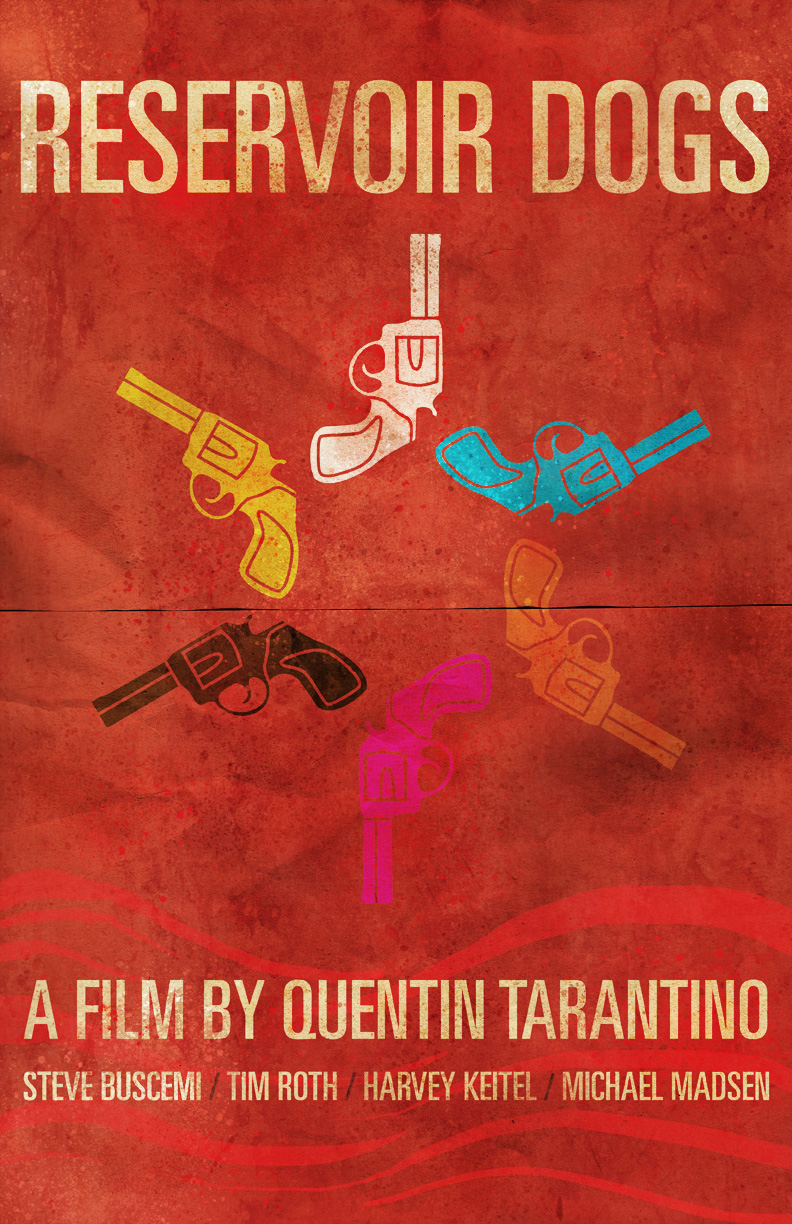
I included Tarantino's Reservoir Dogs in my rundown of great film posters last Saturday, and mentioned that there were quite a few variant versions and assorted promo art inspired by that film that I would have liked to have added if space permitted. Here's a selection for you now. [I'm not sure how many of these were actually commissioned by the distributors for advertising campaigns and how many might just be 'fan art'. The 'ear' one at the bottom is one of a selection of 'Minimalist Movie Posters' by artist Grischa Stanjek on the Atomic Popcorn website.]


Saturday, September 29, 2012

Film List - More Posters

Six months ago, I did a post on some striking posters that I'd dreamed of buying for myself when I was a boy or in my later teens (but never in fact acquired). In the course of researching that, I turned up quite a few more rather memorable designs. Here is a selection.


One of my favourite Westerns.... Sergio Leone's A Fistful of Dollars.


It was only in the last few days that I unearthed this poster for Richard C. Sarafian's Vanishing Point, one of the most memorable of my early experiences in the cinema.


Here is one for Terence Malick's debut picture Badlands: not a great poster (I would have preferred a photo still rather than this over-lurid painting), but the film has a special place in my heart - one of several that I first saw as a boy, late on a Sunday night on BBC2, in their occasional seasons of modern American cinema that was considered too edgy and disturbing to appeal to a wide audience.


Brian De Palma's Scarface was perhaps the most iconic film of my undergraduate days.


And Tarantino's Reservoir Dogs, of course, has spawned a lot of great artwork. This was the classic poster we mostly saw in Britain.


But I rather like this one as well. (I'm pretty sure I have seen this used in promotion for the film; but the only version I can find online at the moment is this text-free one.)


Doug Liman's Swingers was another classic from around that era (odd to think that Vince Vaughan has been a star for over fifteen years now!).


And among more recent releases, I particularly liked the self-deprecating joke in this promo for The Simpsons Movie.


Gosh, I still have quite a lot more of these I'd like to share with you; but I think this is enough for now.


Friday, August 17, 2012

Reception committee

I'm supposed to be back in China round about now.

I hope I get a warmer welcome than Jake and Elwood did in the Cook County Assessor's office.


Saturday, June 30, 2012

Film List - why I don't watch in-flight movies (any more)

Whatever happened to Air India? They gave up their transatlantic routes for some reason?


Back in the '90s, when I first started flying to the States a lot, I would almost always use Air India, since they almost invariably offered the cheapest London-New York fare. And their planes - back then - used to recreate the cheesily fun atmosphere of a Friday night down at the neighbourhood Indian restaurant: pretty, dark-eyed stewardesses making coy the new flirtatious, a tasty curry for the inflight meal, and a Bollywood film to watch. (I am convinced they used to have a flock-wallpaper finish on the cabin interior too; but I worry that my memory may be playing tricks on me about that detail.)

This was my first exposure to Bollywood films, and this was how I came to love them. They make ideal inflight entertainment, because one film lasts most of the flight, it swaps genres so frequently that you have little chance to get bored, and narrative coherence is such a low priority that you can doze off for an hour or two without missing anything too important (so it was in the old days, anyway; I fear the Indian film industry is becoming increasingly 'Westernized' in its approach to narrative form).


These days, though, I never watch a film when I fly.

I was reflecting on this for a while a week or so back, in anticipation of my most recent flight to the States, and it occurred to me that these are some of the reasons for my abandoning film-watching on planes:


Seat-back screens
They're just too damn small. Well, even when we had just a handful of screens to watch in the cabin, they weren't all that big; but the fact that there was only one programme being screened tended to draw you in more, gave it the added appeal of being a communal experience. Moreover, I find everyone else's screens around me extremely distracting. (I'll sometimes find myself half-heartedly watching snatches of a film on a neighbour's screen, without being moved to tune into it on my own.)

Too much noise
Is my hearing starting to lose acuity? Or gaining too much acuity in certain frequencies?? Are airline earphones getting worse? Surely planes can't be getting noisier (more lightweight materials in cabin construction??) - but it seems so. I find now that I can barely hear the inflight entertainment soundtracks even with the volume set to maximum, and the background roar of the airflow outside is still too bothersome for me to maintain my concentration.

Middle-aged weariness
I think I always used to sleep quite easily on planes; but now I can hardly keep awake. This is great for feeling reasonably sprightly when I land, but tends to rule out trying to enjoy a full two-hour film during the flight.

Limited choice
Although at first there appears to be a bewilderingly wide choice, in fact few or none of the titles on offer these days have much appeal for me. I'm not a complete snob about action blockbusters, but if I am going to watch one, it will be in a theatre to get the full experience out of the big special effects and so on (or, at the very least, I'll watch on a big TV screen at home, with the volume turned up high). As a rule, though, I am much more drawn to small independent or foreign films; and how many of those do you get on the inflight programmes? (And the sub-titles would be too small to read on those tiny seat-back screens, anyway.) Every once in a while, a quiet drama or an intelligent rom-com will catch my eye in the listing, but... in the more intimate scenes, I find I'm always struggling to hear the dialogue over the background noise in the cabin.

No more 'exclusivity'
Back in the Air India days, I didn't like to spurn the chance to see one of those Bollywood epics because I had no idea how I'd ever be able to see them again. Even with English-language films, back in the '80s and '90s, I'd sometimes find an inflight film that I knew I wouldn't get around to catching in the cinema and which might never appear on TV, and so I'd give it a try. These days, with multi-channel TV and ubiquitous cheap DVDs, you never have that one-and-only-chance-to-see sensation any more. Now, if I do notice an interesting film advertised on an inflight programme, I think to myself, "I'll get that on DVD when I get back to China."


Saturday, June 23, 2012

Fantasy Girlfriends of Yesteryear - The 'Football Team'

It was Richard Briers, as Tom Good in the '70s BBC sitcom The Good Life, who first introduced me to the idea of making lists of the desirable women one might fantasise over. In one episode he revealed that as a boy he had used to compile teams of 11-a-side to compete in 'cricket matches' using the Owzat dice game. I dallied with the idea for a while, sometimes substituting football for cricket (I had a number of card or dice-based games for football, whereas the venerable Owzat set - the game had perhaps ceased being manufactured in the 1970s - strictly speaking belonged to my brother). I can't now remember exactly who was in my lineups (Tom had favoured the Hollywood glamourpusses of his own childhood in the 1940s: I think Hedy Lamarr was mentioned as one of his most formidable bowlers), but it is highly likely that the ladies below would have been among them - all young actresses who appeared frequently on British TV during my childhood in the later '70s and early '80s, and whose exceptional prettiness left an indelible impression on me.

Since that time, thoughts of sport have been inextricably linked in my mind with thoughts of beautiful women; hence the idea for this post emerges out of my recent obsession with the unfolding European Football Championship. I suspect it works the other way for me as well, that I have a Pavlovian reflex to think of sport whenever I see a pretty girl - something that has probably not been helpful to me in attempting to forge romantic relationships.

I've produced a list of twelve lovely ladies here, since cricket traditionally allowed only one substitute, and back in the 1970s football did too (this allowing multiple substitutions, and having most of your squad on the bench to choose from, is a newfangled rule change I still turn my nose up at). I haven't bothered to try to come up with a tactical formation for them (although as a ten-year-old I would have done!).

It was hard to trim my selection down this far. A few strong contenders had to be omitted: Jenny Agutter (who I'd better give a 'Fantasy Girlfriend' post all of her own one day; or my pal The British Cowboy, for one, will never forgive me), Sheila Ruskin (a rather good actress who, unfortunately, became forever tainted in pop-culture-land by having a terribly hammy part in a 1981 Dr Who episode), Francesca Annis (who was Estella in a 1960s BBC serialisation of Great Expectations, and got her kit off [as we Brits like to put it] to play Lady Macbeth for Roman Polanski round about 1970... although I didn't see that until much later!), and Natalie Ogle, a china-doll pretty waif of a girl who got a run of parts in BBC1 Sunday afternoon 'classic serials' in the late '70s, Little Nell and Lydia Bennett (I saw her on stage at the Oxford Playhouse many years later, and she was still rather breathtaking; still is today, it seems!). And, of course, I've already celebrated a number of my other favourite actresses from that era in their own posts in this series: Diana RiggJane Seymour, Jan Francis, Patricia Hodge, Gabrielle Drake, and Felicity Kendal (whose most famous role was as Tom Good's wonderful wife Barbara in that TV show I mentioned at the outset).

But THIS is my....


1970s 'Fantasy Football' Glamour Team

Fiona Fullerton
I first became smitten when she appeared in Angels, an early 1970s BBC drama series about student nurses. I confess to a bit of a weakness for a nurse's uniform! Shortly before that (I was later to discover), she had been the most inappropriately grown-up and embarrasingly fanciable Alice In Wonderland; shortly after, she would go on to a string of forgettable glamour roles, including an appearance as a Bond girl.


Jenny Hanley
This rather lovely actress had a few conventional glamour parts in horror films and such early in her career, but then settled into a regular gig as a presenter on Magpie, an ITV children's magazine programme - which gave me a lot of exposure to her as I was growing up. I adored her voice, as well as everything else about her.


Barbara Kellerman
Possibly the most beautiful woman in this very beautiful team (Jewish girls are another recurring weakness of mine), and probably the tallest too. I first saw her as a nurse (are we seeing a pattern here already?) in a medical soap called General Hospital, but she went on to play dozens of other TV parts during the 1970s.


Lesley-Anne Down
Or I should perhaps say Lady Georgina Worsley, the part that she played in the popular period drama Upstairs, Downstairs. She soon got drawn away to a career in Hollywood, but it was that early role as the Bellamys' flighty niece that enraptured me. I remember there was one episode where she took a rather raunchy part in a silent film, playing a slinky seductress in a Parisian café: beret, long cigarette-holder, and black silk stockings. One of the most memorable erotic images of my young life! Unfortunately (or fortunately?) I couldn't find a picture of that. So, I plumped for one from when she became a nurse during WWI instead.


Emma Samms
Another rising star who, like Lesley-Anne Down and Jane Seymour, was promptly stolen from us by the greedy magnates of American television. I believe she had a long-running part in Dynasty or something, but I never watched any of that junk. I remember her chiefly from the 1979 film Arabian Adventure. (Arabian princess costumes even beat a nurse's uniform in the fetish stakes!)


Lea Brodie
Billed as Lea Dregorn in a few of her earliest appearances (not sure if she got married young, or just decided that her real name was proving a bit of a handicap in showbusiness), she unfortunately didn't have a very long career. She cropped up a few times on TV in shows like Space: 1999, but she's only really remembered for playing an almost-Arab-princess type glamour role in the low-budget action romp Warlords of Atlantis. Best legs I've ever seen!


Caroline Munro
I feel a bit bad about including her as an 'actress' since, despite scores of film roles over the years (mostly in horror films), I've never seen any evidence that she can act at all. She was, however, quite outrageously sexy, possibly the most universally lusted after woman in the UK from the late '60s through to the early '80s. She was best known as the 'face' of Lamb's Navy Rum in a long-running series of calendars and glamour posters. However, she showed admirable resolve in refusing ever to do any nudie stuff - despite being supposedly offered a king's ransom by Hef to appear in Playboy. I think the only true 'starring' role she landed was as space-age swashbuckler Stella Star in the dreadfully cheap-and-cheesy Barbarella/Star Wars ripoff Star Crash (rated at 3.8 out of 10 by IMDB, the lowest score I think I've ever seen on there). This film occasionally strays into so-bad-it's-good territory: Christopher Plummer, slumming it for a paycheck as the Galactic Emperor, has one of the most brilliant lines ever uttered on film - "Imperial Battleship, halt the flow of Time!"

And here she is in motion, in a raunchy little TV ad from the early '70s for a popular brand of mini cigar.


Cherie Lunghi
In contention for an award as the most prolific TV actress of all time, and not only beautiful but always emanating such élan, such coolness, such class. She was notorious for a short while for having (almost subliminally briefly) got her kit off as Guinevere in John Boorman's Excalibur, but I think I remember seeing her first as one of Edward VIII's former girlfriends in an ITV series about the 1936 abdication crisis (making his choice of Wallis Simpson completely unfathomable).


Anne-Louise Lambert
An Australian actress best-known for her bewitching performance in Peter Weir's hauntingly beautiful Picnic At Hanging Rock (which I tend to cite as the most erotic film I've seen - to general derision from people who expect their eroticism to involve actual sex): her character, a 17-year-old schoolgirl called Miranda, is memorably described as "a Botticelli angel". In her mid-twenties she moved to England to develop her career, but the first part she got was as Lucrezia Borgia in The Borgias, a series widely derided as one of the most inept costume dramas the Beeb ever produced. Fortunately, she did continue to get regular work after this, but never achieved the major stardom that had seemed on the cards after Picnic.


Olivia Newton-John
Another pick I feel a little embarrassed about including in a lineup of actresses, since her acting was really pretty horrible. But damn - she looked mighty fine. I knew her mostly through appearances as a singer. I never saw Grease (was irretrievably prejudiced against it by the irritatingness of all the hit singles it spawned, and how long they clogged the upper reaches of the charts that year). However, I did somehow (I can't remember how: this is not a film I would ever have made the slightest effort to see) catch her follow-up, Xanadu, which is quite possibly the silliest film ever made - but she looks smoking hot throughout.


Lynne Frederick
She later became a prime target of tabloid gossip-mongers as the last wife of Peter Sellers, and died before the age of 40 after troubles with alcohol and depression. However, her early career showed a lot of promise, and she happens to have appeared in three films I particularly like: the fabulous children's story The Amazing Mr Blunden, and two unusual sci-fi thrillers, Phase IV and No Blade of Grass.


Lysette Anthony
I had thought she was another of those young beauties who'd deserted our shores in search of big bucks in America, but her IMDB resumé indicates that she's worked consistently in British TV. I'm not sure quite how she impinged on my consciousness, since she's only a little older than me and didn't really get her career going until I'd gone to college (at which point I didn't watch TV much any more). I think I saw her in a TV movie of Ivanhoe in the early '80s.